
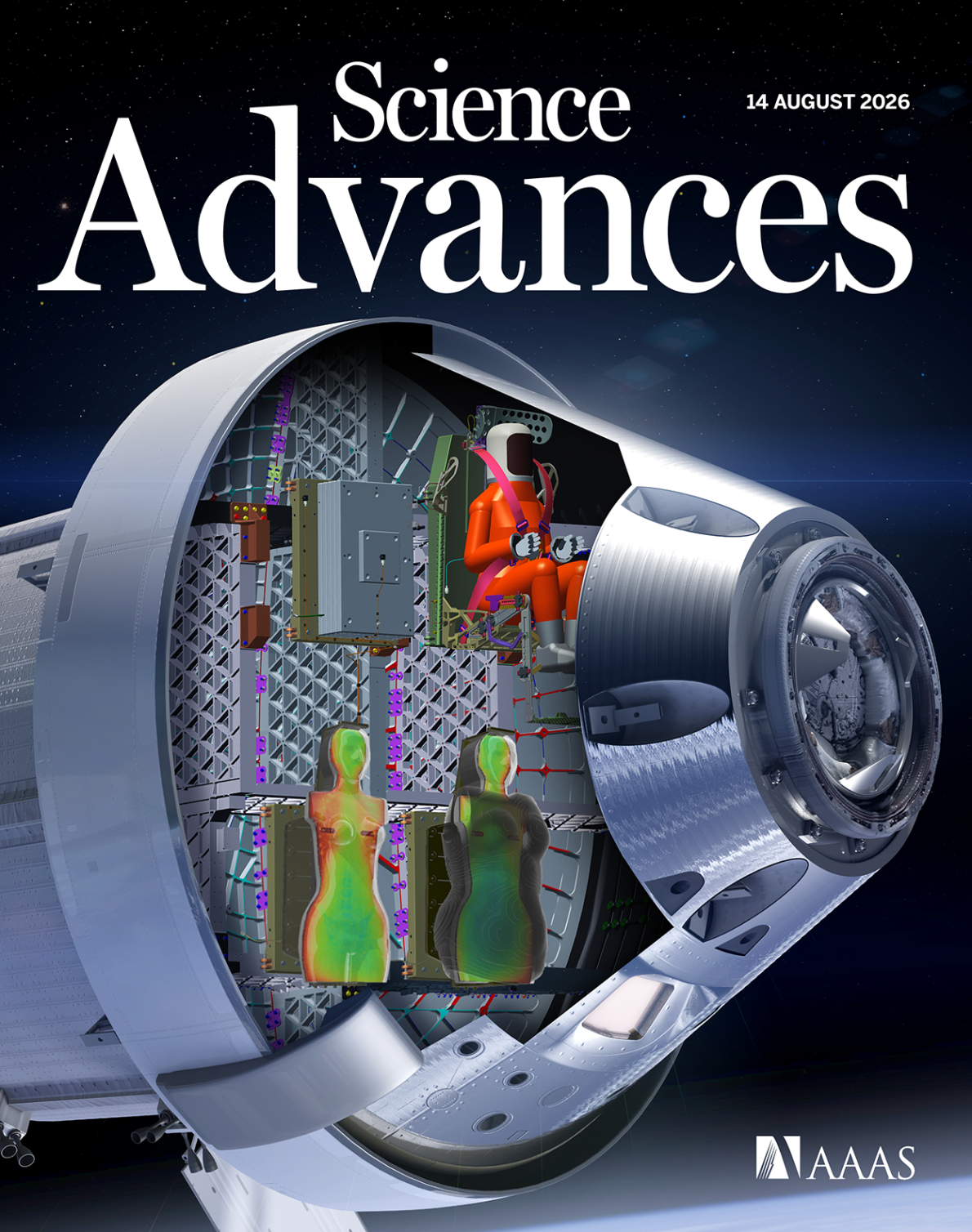
A radiation-shielding vest tested during NASA's Artemis I mission could significantly reduce astronauts' exposure to dangerous solar radiation during future deep-space missions, according to a new study published in Science Advances. The study was selected for the journal's August 14 cover.
The international research team, which included investigators from the Duke Department of Radiology, found that the vest could reduce radiation exposure by up to 60% during major solar particle events, helping support safer journeys to the moon, Mars, and beyond.
Ehsan Samei, PhD, FACR, and W. Paul Segars, PhD, from the Department of Radiology and the Center for Virtual Imaging Trials (CVIT) at Duke University were co-authors of the study. CVIT is a national NIH-sponsored research center to advance in silico (computer simulated) trials and digital twins in medicine.
Researchers evaluated the effectiveness of the AstroRad vest using data collected during the Matroshka AstroRad Radiation Experiment (MARE) aboard NASA's Artemis I Orion spacecraft. The vest is designed to shield radiation-sensitive organs, including the lungs, stomach, colon, breast tissue, ovaries, and bone marrow.
Two “phantoms” — life-sized female torso models designed to mimic human tissues — traveled around the moon inside the Orion spacecraft. One wore the AstroRad vest while the other did not, allowing researchers to directly measure the vest's protective effects.
The project used highly detailed computer-generated human models developed by Duke Radiology, called XCAT phantoms, to simulate the internal body properties and radiation conditions experienced by the physical phantoms. The researchers validated the simulations against radiation measurements collected during the mission.
The team then used the computational models to investigate a worst-case scenario that couldn’t be directly tested: how effectively the vest would protect astronauts during a major solar particle in deep space.
The research team found that the AstroRad vest could reduce astronauts’ radiation exposure during a major solar particle event by approximately 40% to 60%, potentially giving an astronaut up to 193 extra days of permissible time in deep space. This protection was comparable to Orion’s cargo-bay storm shelter, with the added benefit of allowing astronauts to remain mobile and continue mission-critical operations.
“The XCAT human phantoms have a long track record of enabling virtual studies in situations where experiments in people would be difficult or impossible. Here, we had a rare opportunity to validate our computational models against measurements from an actual mission in deep space,” said Segars, deputy director of CVIT and the original developer of the XCAT phantoms.
By demonstrating the potential of combining computational modeling and targeted radiation shielding, Samei said this research could help shape how astronauts are protected during the next generation of deep-space exploration missions.
“This study not only advances human space exploration but also provides a strong demonstration of the power of computational modeling across a broad spectrum of scientific needs, from medicine to radiological safety to space missions,” said Samei, director of CVIT.